Introduction
Warehouses do not only store cartons and pallets.
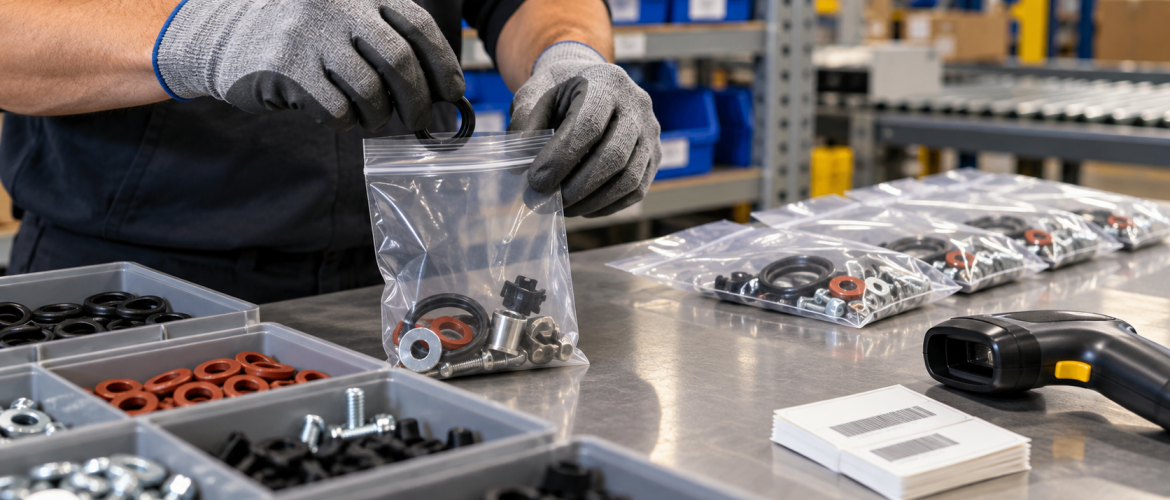
Many operations also manage thousands of small items such as screws, washers, clips, spare parts, connectors, accessories, samples and repair components.
These items can be difficult to count, identify and issue when stored loose.
Resealable bags can provide a simple way to group small components while allowing the bag to be opened and closed again when access is required.
DeMegha’s existing resealable bags page already explains different bag formats, materials, closures and general storage applications.
This article takes a different approach: how warehouses can incorporate resealable bags into small-parts inventory and kitting workflows.
Why Small Parts Create Warehouse Problems
Small components are easy to mix, miscount, drop, misplace or send to the wrong department.
When several similar components share the same storage bin, identification becomes even more difficult.
Use One SKU Per Bag Where Practical
One of the simplest inventory rules is to avoid mixing different SKUs inside the same unmarked bag.
A bag can contain SKU M6-BOLT-025, description M6 bolt 25 mm, and quantity 50.
This makes picking and counting easier.
Add an Identification Label
Clear resealable bags allow contents to remain visible, but visual identification alone may not be enough.
A label can include SKU, product name, quantity, batch, location, barcode and date. DeMegha’s barcode labels range can support this type of identification.
This creates a link between the physical components and the inventory system.
Use Resealable Bags Inside Storage Bins
A bin can contain multiple bagged components instead of loose pieces.
For example, Bin A12 might contain one bag of screws, one bag of washers and one bag of clips.
This can reduce mixing while still keeping related parts in one location.
Separate Similar-Looking Components
Small parts may appear nearly identical but have different diameters, lengths, grades, colours or specifications.
Individual resealable packaging can reduce accidental mixing.
Use Bags for Maintenance Kits
Maintenance teams often need several components for one task.
Instead of technicians collecting each item separately, a warehouse can prepare a kit.
For example, a pump maintenance kit could contain four seals, six washers, two clips and four fasteners.
The complete set can be placed inside a suitably sized resealable bag and labeled.
Use Kits for Installation Work
Resealable bags can also support installation projects.
A single kit can be prepared for one workstation, one equipment unit, one repair or one customer order.
This reduces repeated picking.
Include a Packing Checklist
For multi-component kits, place a small checklist inside or on the bag.
The picker can verify the contents before sealing.
Barcode the Kit
If the warehouse uses barcode scanning, the outside of the bag can carry a kit barcode.
Scanning can identify kit number, work order, product, customer or project.
The exact setup depends on the warehouse software.
Use Different Sizes Instead of Excessively Large Bags
A bag that is much larger than the contents can be inconvenient.
Correct sizing can improve storage density, presentation, counting and bin organization.
DeMegha’s existing resealable-bag offering, including ZIP lock bags, covers different dimensions and customization options.
Consider Thickness According to the Contents
Light items place different demands on packaging from sharp or heavy components.
When selecting a bag, consider weight, edges, repeated handling and storage duration.
Do not choose thickness based only on price.
Avoid Sharp Components That Can Puncture the Bag
Parts with sharp edges may require a heavier construction, protective wrapping or different packaging.
Always test with the actual item before standardizing.
Colour Coding Can Support Sorting
Where appropriate, different labels or bag markings can help identify department, project, priority or inspection status.
Avoid creating too many colours, as that can become confusing.
Use Resealable Bags for Returns to Stock
Maintenance staff may take ten pieces but use only seven.
The remaining three can become difficult to manage if returned loose.
A resealable container makes it easier to return unused components while preserving identification.
Update the Quantity After Partial Use
Do not rely on the original label if the bag quantity has changed.
If five pieces are removed from a bag of 20, update the quantity according to the warehouse process.
Inventory accuracy depends on both packaging and system discipline.
Use Bags for Quality-Control Samples
Small retained samples can be placed in identified bags with information such as batch, date, product, inspector and sample reference.
The bag helps keep sample items together.
Incoming-Goods Sorting
Resealable packaging can also help when bulk shipments need to be divided into smaller internal quantities.
For example, 1,000 components may be divided into 20 bags of 50 units.
This can simplify later issuing.
Pre-Count Frequently Issued Quantities
If technicians regularly request ten pieces at a time, the warehouse can consider pre-counted packs.
This may reduce repetitive counting during busy periods.
Keep Bag Specifications Standardized
Warehouses should avoid accumulating too many nearly identical bag sizes.
Create a controlled list such as small, medium, large and heavy-duty application.
This can simplify procurement and storage. For dispatch rather than internal storage, e-commerce pouches may be a separate, more suitable category.
Do Not Use Ordinary Bags for Specialized Protection Without Verification
Some components may require specific protective packaging because of static sensitivity, hazardous contents, regulatory requirements or chemical exposure.
A general resealable bag should not automatically be substituted for specialized packaging.
DeMegha separately offers packaging categories including anti-static bags and security solutions, demonstrating why the intended application should be considered before substituting packaging types.
Warehouse Resealable Bag Workflow
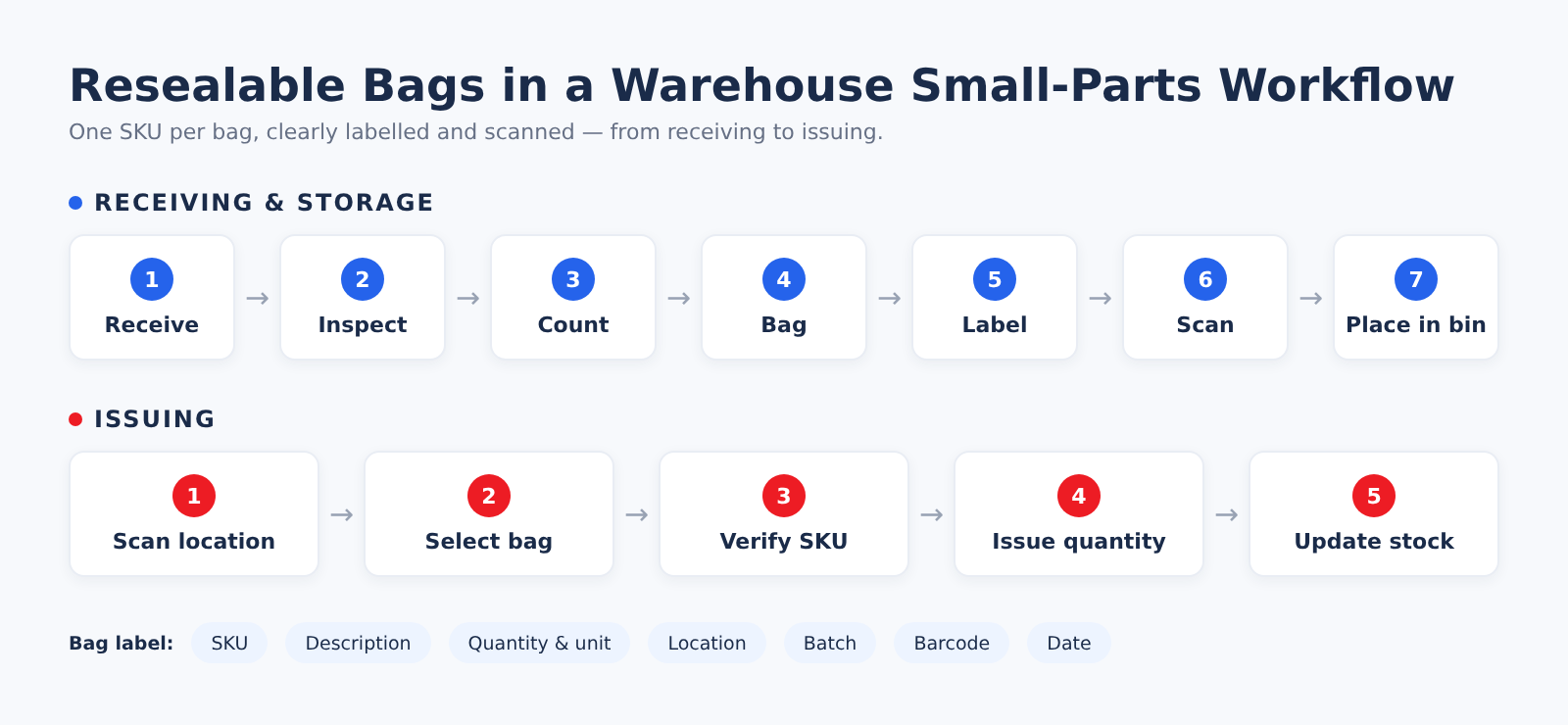
A practical workflow for receiving can be:
- Receive components
- Inspect
- Count
- Bag
- Label
- Scan
- Place in bin
For issuing:
- Scan location
- Select bag
- Verify SKU
- Issue quantity
- Update remaining stock
What to Include on a Warehouse Bag Label
Consider SKU, description, quantity, unit, location, batch if relevant, barcode and date.
Avoid unnecessary information that makes the label difficult to read.
Benefits of Using Resealable Bags in Small-Parts Storage
A controlled system can support:
- Better separation
- Faster picking
- Easier kitting
- Cleaner storage
- Repeat access
Conclusion
Resealable bags can become more than simple packaging when integrated into a warehouse system.
They can support SKU separation, pre-counted inventory, maintenance kits, installation kits, returns to stock and sample management.
The key is to combine the bag with clear identification, controlled quantities and suitable warehouse procedures.
That creates a different operational use from simply treating resealable packaging as a general storage bag.
For businesses in the UAE looking for resealable bags in suitable sizes and specifications, contact DeMegha to discuss quantities and packaging requirements.
Frequently Asked Questions
1. Can Resealable Bags Be Used for Warehouse Parts?
Yes. They can be useful for grouping and identifying suitable small components.
2. Should Each SKU Have a Separate Bag?
Separating different SKUs can reduce accidental mixing where practical.
3. Can Resealable Bags Be Labeled with Barcodes?
Yes, provided the label and barcode are suitable for the inventory workflow.
4. Are Resealable Bags Useful for Maintenance Kits?
Yes. Several required components can be grouped into one identified kit.
5. Should Quantity Be Shown on the Bag?
Displaying and updating quantity can support picking and inventory control.
6. Can Ordinary Resealable Bags Be Used for Electronic Components?
Not automatically. Static-sensitive electronics may require specialized protective packaging.